
The Great Semiconductor Valuation Reset
AI Demand Is Still Alive. The Market Is Just Pricing It Differently.

© 2026 Street Alpha. All rights reserved.
Disclaimer: This article is for informational and educational purposes only. It does not constitute financial, legal, or geopolitical investment advice. The views expressed are based on public intelligence and analytical frameworks as of the publication date and are subject to change without notice. Readers should conduct their own research or consult professional advisors before making any investment decisions.
The Bottom Line
The semiconductor selloff does not mean AI demand has collapsed. Nor does it point to a systemic deterioration in industry fundamentals.
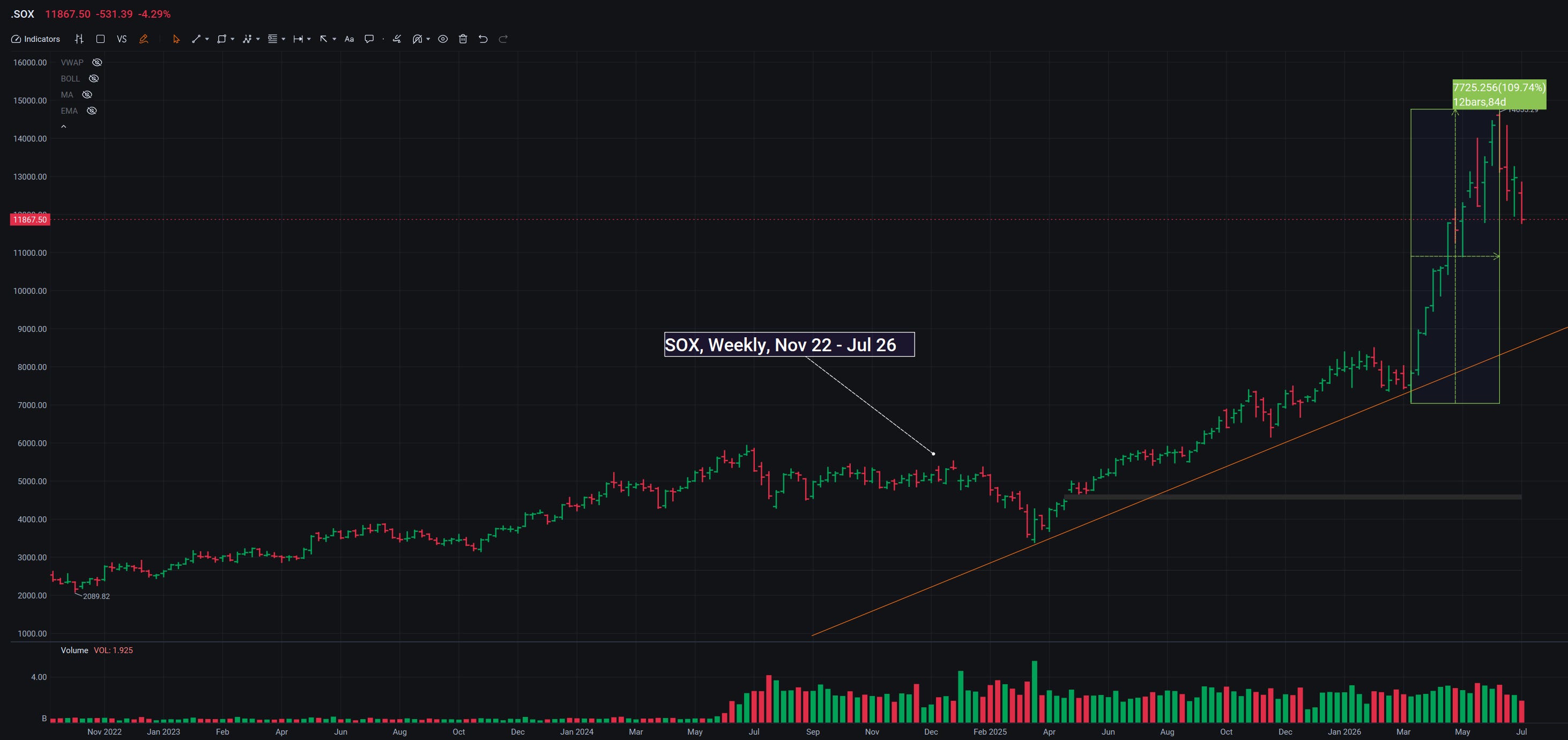
What the market is doing instead is separating four distinct sources of profit that, over the past two years, were bundled together and awarded the same growth-stock multiple:
Structural growth from the long-term adoption of AI
Cyclical profits created by rapidly accelerating capital expenditure
Pricing and margin premiums generated by supply shortages
Valuation premiums driven by crowded positioning, leverage and ETF inflows
During the rally, all four were packaged into a single “AI supercycle” narrative. Cyclical earnings, shortage economics and structural growth were effectively valued as if they were interchangeable.
Now the market is pulling them apart.
Investors are asking which earnings have already been realized, which reflect peak-cycle conditions and which still depend on assumptions about 2027, 2028 or even later.
That helps explain the apparently contradictory price action. Apple has reached an all-time high. Nvidia has held up relatively well. Meanwhile, Micron, Marvell, Kioxia, ARM and Coherent have suffered severe drawdowns.
The market is repricing one question: How far into the future am I still willing to pay for today?
The answer used to be three to five years. It may now be closer to one or two.
The Original Thesis
From 2024 through 2025, investors were responding to a set of real and mutually reinforcing fundamental developments:
Hyperscalers repeatedly raised capital-expenditure plans
GPUs, HBM, advanced packaging and optical interconnects remained supply-constrained
Earnings expectations rose for suppliers such as Micron, Marvell and Coherent
AI demand expanded from training into inference and agents
Data-center construction remained constrained by power, networking and supply-chain bottlenecks
Supplier revenue repeatedly exceeded the market’s prior expectations
These developments justified higher stock prices. The fundamental foundation of the rally was not wrong.
The problem was how aggressively the market extrapolated it.
When a rally becomes powerful enough, investors tend to treat every form of growth as permanent. Cyclical profits receive secular-growth multiples. Temporary shortages are interpreted as durable competitive moats. Order visibility becomes synonymous with earnings certainty.
But the long-term AI adoption curve and the AI capital-expenditure cycle are not the same thing.
AI may become a general-purpose technology that reshapes the economy for decades. Hyperscaler CapEx growth can still peak within a few years. Internet traffic continued to grow while telecom equipment passed through brutal investment cycles. Cloud computing continued to expand while servers, storage and networking equipment repeatedly experienced inventory corrections.
The secular technology trend determines the long-term demand floor. The capital cycle determines the path of orders, margins, earnings and stock prices along the way.
Growth Is Not Enough
The market is no longer asking whether AI capital expenditure is still growing. It is asking whether the rate of growth can continue accelerating.
Suppose CapEx rises from 100 to 150. That is 50% growth. If it then rises from 150 to 165 the following year, the absolute level reaches another record, but the growth rate falls to 10%.
Supply-chain revenue can continue rising even as the stocks peak. Markets do not price the absolute level of activity in isolation; they price the future direction and rate of change.
The questions have therefore changed:
Can CapEx growth continue accelerating?
Have the largest upward earnings revisions already occurred?
How long can supply constraints persist?
Will incremental capital generate sufficiently attractive returns?
How many years of exceptional growth are required to justify current valuations?
The most important variable is the return hyperscalers can generate on their AI investments.
As long as investors believe AI infrastructure spending will eventually produce adequate returns, they will pay today for earnings expected in 2028. But when proof of ROI arrives more slowly than capital spending expands, the market does not necessarily cut its near-term demand forecasts immediately.
It shortens the time horizon it is willing to underwrite.
The transmission mechanism looks like this:
Lower ROI visibility → shorter underwriting horizon → heavier discounting of distant earnings → lower valuations for long-duration equities → deleveraging of crowded positions → stock-price declines that exceed the change in fundamentals.
The Duration De-Rating
Duration is traditionally a bond-market concept. It measures how sensitive an asset’s value is to changes in discount rates and the timing of its future cash flows.
The same principle can be applied to equities.
A company whose valuation is supported primarily by cash flows expected over the next one or two years has relatively short duration. A company whose valuation rests largely on earnings three to five years into the future is a long-duration equity.
A duration de-rating does not necessarily mean the market believes those future earnings will disappear. It means investors are no longer willing to pay the same price today for profits that remain several years away.
The old valuation may have assumed: Today’s exceptional growth can continue for another five to seven years.
The new valuation may assume: The next one or two years still look strong, but everything beyond that must be proved again.
Only modest changes to fundamental forecasts may be required to produce a substantial change in valuation. Long-duration assets are extraordinarily sensitive to the number of years over which elevated growth is assumed to persist.
That is the common problem facing Coherent, Marvell, Kioxia and parts of the ARM thesis. Their long-term opportunities may remain intact, but a meaningful share of their value depends on 1.6T optics, custom ASICs, co-packaged optics, data-center CPUs and other projects ramping on schedule over the next several years.
Why Good Companies Fall
As an investor with a research background, I often ask myself:
If a company has already returned to fair value, why are buyers still not stepping in?
The answer is that valuation can tell us what earnings expectations are embedded in a stock price. It cannot tell us how much forced selling remains in the market.
During an ordinary correction, lower valuations attract long-term capital. During the unwinding of a crowded trade, however, the market must first solve a balance-sheet problem.
If leveraged ETFs, momentum strategies, volatility-control funds and active managers all reduce risk simultaneously, sellers must transact immediately while buyers retain the option to wait. In a negative-gamma environment, dealer hedging can further amplify intraday volatility.
Prices can therefore fall below an analyst’s estimate of fair value.
That does not make valuation analysis irrelevant. It means valuation is not the only determinant of short-term prices. Cash flows ultimately determine value, but marginal buyers, leverage and liquidity determine the path taken to get there.
Most investors may still believe in the long-term AI story. If incremental buying slows while a relatively small pool of leveraged capital begins selling aggressively, prices can still move very quickly.
Stress-Testing Valuations
To frame the current environment, I have compressed the valuation multiples of several industry leaders whose underlying fundamentals remain intact.
These are deliberately imposed stress scenarios rather than formal revisions to the companies’ operating outlooks. The objective is to estimate what could happen if the market demands a much larger discount for distant earnings.
Micron
My original valuation framework for Micron was based on approximately $121 of non-GAAP EPS in FY2027 and a 12 to 15 times exit multiple, producing a target price of roughly $1,600.
That framework was not especially aggressive. A 12 to 15 times multiple is hardly extreme for a memory company experiencing strong earnings growth.
In a duration-de-rating scenario, however, the multiple could compress to only six or seven times, implying a value of approximately $640 to $750. With the shares recently trading around $853 to more than $900, the market price sits somewhere between the compressed scenario and the original base case.
Micron also has a form of downside protection that other memory suppliers do not. The company has entered into approximately 16 long-term supply agreements, involving roughly $100 billion of minimum purchase-price commitments, approximately $18.4 billion of cash deposits and around $4 billion of letters of credit.
Those agreements cover an estimated 25% of expected revenue and should provide meaningful protection to the earnings floor. But they cannot prevent the market from applying a lower valuation multiple.
Kioxia
Among these companies, Kioxia carries the greatest duration risk.
The stock fell from an all-time high of ¥112,700 on June 22 to approximately ¥52,110 intraday on July 17, a decline of about 54%. It has also fallen below the original June 2 entry anchor of ¥72,200.
Applying a 25 times multiple to near-term EPS produces an earnings-supported value of approximately ¥25,300, or 51% below the current share price.
That places the stock in a high-risk valuation zone. A substantial portion of today’s price continues to depend on assumptions about FY2027 and FY2028 earnings rather than profits that have already been fully realized.
Marvell
Marvell’s problem is the amount of time required for the earnings thesis to mature.
My previous probability-weighted target was based on approximately $6.40 of FY2028 EPS and a 38 times exit multiple. By contrast, the valuation supported by FY2027 alone is approximately $154, around 18% below the recent share price of roughly $188.
Marvell also has significant exposure to hyperscaler investment decisions. Data-center revenue represents approximately 74% of the business under my CapEx ROI-dependency framework, while the revenue contribution from NVLink Fusion, Google TPU programs and co-packaged optics is still ahead of us.
The opportunity may be real. The problem is that much of the earnings realization remains in the future.
ARM
ARM has fallen from its June high of approximately $407 to around $262, a decline of roughly 36%. That takes the stock almost all the way back to the $256 level at which I began researching the company in May.
The problem is that two unresolved risks already present at $256—the FTC investigation and supply-chain concentration—have not improved materially.
The Meta Compute development has introduced another risk: a hyperscale customer may evolve from being a buyer into a competitive supplier.
ARM is an IP-licensing company. It earns architecture licence fees and royalties on every chip sold, so it is not a direct recipient of capital expenditure in the same way as an equipment or component supplier.
Yet the market still places ARM in the same AI CapEx basket. The reason is that the data-center revenue assumptions surrounding AGI CPU silicon depend on hyperscalers continuing to build infrastructure at the current pace. If construction slows, the growth path for data-center royalties is delayed.
NOTE: These scenarios are my own deliberately imposed numerical adjustments. I am trying to construct a rational framework for the market’s behavior—but the market does not owe us a rational explanation.
Why Nvidia Holds Up
Nvidia is also highly dependent on hyperscaler capital expenditure, yet it has held up better than most companies in the AI supply chain.
The reason is that its earnings are closer to the present.
Data-center GPU revenue and profits are already appearing in Nvidia’s financial statements. Investors do not need to wait three years for a project to enter volume production, nor do they need to depend entirely on long-term product assumptions that have yet to be validated.
The CUDA ecosystem, networking portfolio and system-level solutions also provide a deeper competitive moat.
Put differently, Nvidia faces the question: How long can today’s extraordinary profits last?
Many other AI suppliers face a different question: Will the extraordinary profits expected in the future arrive on time?
Both are exposed to the same capital-expenditure cycle, but their earnings have very different durations.
That does not make Nvidia immune. If hyperscalers begin cutting CapEx or if the marginal return on new GPU investment continues to decline, Nvidia cannot completely escape the broader capital cycle.
It is simply positioned at the front of the monetization chain.
Why Apple Is Winning
Apple provides the clearest contrast.
Its core revenue comes from devices, services, subscriptions and its platform ecosystem. Those cash flows already exist. They do not require investors to wait for another AI data center to be built, nor do they depend on a hyperscaler project scheduled to monetize in 2028.
For Apple, AI is more of a product and ecosystem enhancement than a condition for the survival of its core business model.
When the market shortens the time horizon it is willing to underwrite, capital naturally migrates toward companies with:
Greater visibility into current free cash flow
Lower customer concentration
Less dependence on a single capital-expenditure cycle
The ability to support per-share value directly through buybacks
Apple reaching a record high while semiconductor stocks collapse is therefore not a contradiction.
Both outcomes reflect the same rotation: away from distant growth and toward cash flow that already exists.
Breadth Is Deteriorating
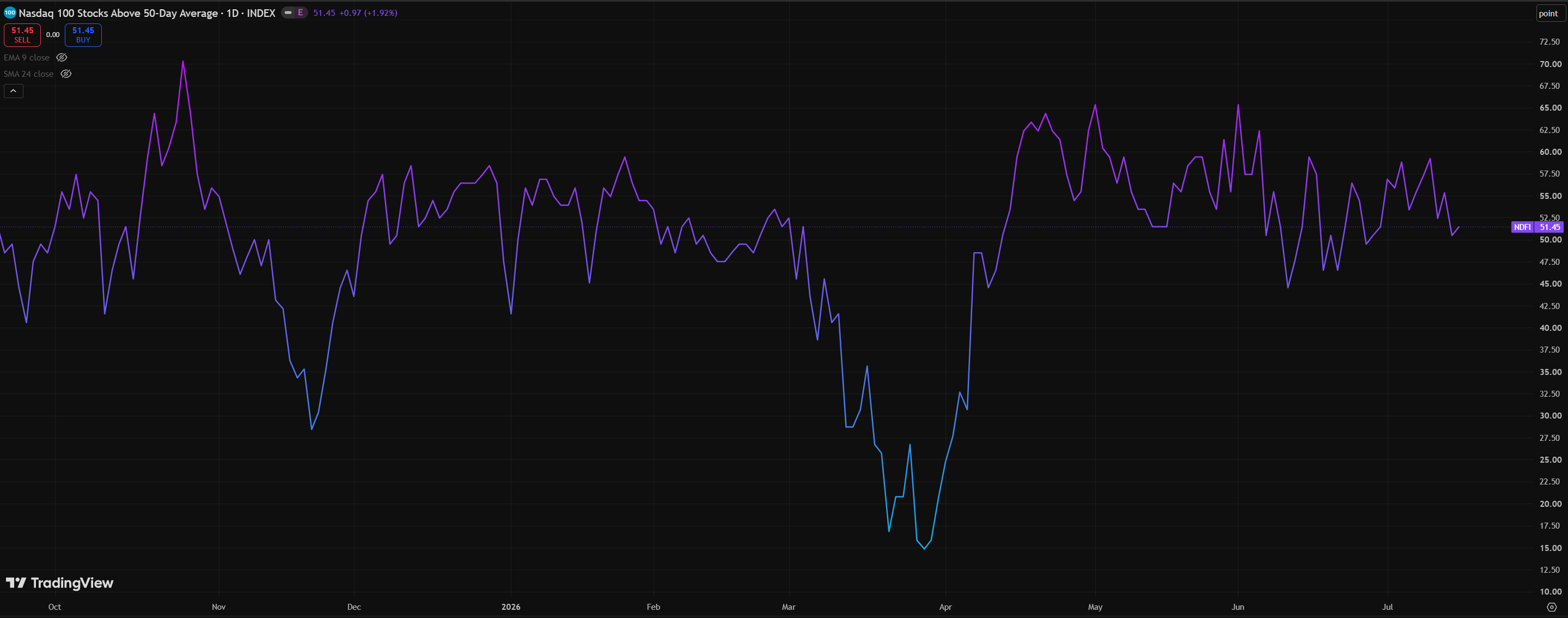
The most concerning signal is not simply the decline in semiconductor stocks. It is the continued narrowing of market breadth.
The equal-weighted S&P 500 has persistently underperformed its market-cap-weighted counterpart, indicating that index performance is becoming increasingly dependent on a small group of very large companies.
At the same time, the percentage of Nasdaq constituents trading above their 50-day moving averages has formed a pattern of lower highs and lower lows. Fewer stocks are participating in the market’s advance.
The Magnificent Seven and financial stocks have absorbed some of the capital rotating out of semiconductors, preserving the appearance of stability at the index level.
But this stability is concentrated rather than broad. It looks more like defensive reallocation than a genuine recovery in risk appetite.
There are two likely paths from here:
Semiconductor stocks stabilize, capital returns to the sector, market breadth improves and the indices resume their advance
Large platform companies and financial stocks also come under pressure, removing the market’s remaining support and forcing the indices to catch down
What a Bottom Looks Like
The liquidation phase may end without an obvious positive catalyst.
A more reliable signal will come from the market’s response to information:
Stocks stop making new lows on bad news
Gains following positive announcements persist instead of being reversed the next day
High-volume rebounds hold for several sessions
The former leaders of the decline stop making new relative lows
Semiconductor breadth improves before the headline index
Earnings estimates continue falling, but stock prices stop following them lower
Core assets such as Nvidia and TSMC begin showing high-volume relative strength
Hyperscalers maintain or raise CapEx while providing clearer evidence of revenue generation and ROI
A stock reaching a technical support level does not mean the liquidation has ended.
The bottom is in only when marginal supply has been absorbed and the market’s reaction function begins to change.
The Four-Stage Framework
Where this selloff ultimately leads depends on which of four stages it reaches.
Stage one is multiple compression. The market still believes the earnings, but it is no longer willing to assign them the same valuation.
Stage two is position liquidation. Fundamentals remain largely intact, but leverage, momentum and concentrated positioning cause stock prices to fall much more than earnings expectations.
Stage three is earnings downgrades. Order delays, slower product ramps or falling prices begin to affect supplier forecasts.
Stage four is a reversal of the capital cycle. Financing constraints or inadequate returns cause hyperscalers to reduce CapEx, changing the revenue and profit trajectory of the entire AI supply chain.
If the correction remains within the first two stages, it should eventually create a new buying opportunity.
If it enters stage three, investors will need to become more selective, favouring companies with shorter earnings duration and clearer present-day cash flows.
If it progresses to stage four, the decline can no longer be treated as a simple valuation adjustment. The earnings cycle of the entire AI supply chain will need to be recalculated.
What Matters Now
AI has permanently raised the demand floor for the semiconductor industry. That thesis remains intact.
But a higher demand floor does not eliminate the cycle. Nor does a decades-long technological revolution mean every participant deserves a growth-stock multiple indefinitely.
Over the past two years, the market combined structural growth, cyclical earnings, supply scarcity and liquidity premiums into one story. It is now separating those sources of value and pricing them according to when the earnings will arrive, how long they can persist and whether the capital required to produce them can generate an adequate return.
The central question behind this selloff is therefore not whether AI is over.
It is this: How far into the future is the market still willing to pay for AI profits today?
Long-term AI demand can remain strong while AI stocks experience a deep bear market. The industry trend determines the destination; capital structures, positioning and liquidity determine the path taken to get there.
The most important research task now is not to identify another technical support level.
It is to determine whether the selloff remains a valuation reset and position-clearing event—or whether it has started to affect hyperscaler financing capacity, investment returns and capital-expenditure decisions.
The former eventually creates an opportunity.
The latter means the entire earnings cycle must be rewritten.